Tuesday, 25 July 2017

the best online business which can give a monthly income of $1000 a month

the best online business which can give a monthly income of $1000 a month

There are various business models that can bring you $1,000 a month but I will give you a business model that has worked for me and many others. Also it’s very easy to begin with and requires no programming skill or any specialized skill set for that matter. You just need to have some patience and decent addition/subtraction skills.


The business model I present to you is starting your own Amazon FBA selling business. FBA stands for fulfillment by Amazon. What this means is you provide inventory to Amazon for certain products of your choosing and send it to an Amazon warehouse. Once Amazon receives it they will take care of things like advertising, customer support, and selling the item itself. Let’s go a bit more in-depth now.
Let’s say you find a toy that costs $5 at Walmart.com. And then you do some searches on Amazon and you see that same toy is being sold for $20 on Amazon. As you can see there is a potential $15 profit margin. However, there are fees as you may have predicted. Because it’s Fulfillment by Amazon, they will charge some fees for their service. But remember, they are doing the hard work which is advertising, storage, customer support, and selling the item. You don’t have to deal with any of that. Amazon charges a small fee based on the items price and weight. Also there is shipping costs for you when you send products to Amazon. But when you sign up for an Amazon sellers account you will have the option to use UPS which is Amazon’s partner carrier and they have great shipping rates for merchants. I’ve shipped items for as low as $0.30 which is basically shipping heaven for every merchant. Anyways, you can expect the fees to be around $5 which include shipping fees. And let’s say your down to a $10 profit margin now. So each unit can make you a $10 profit. Now imagine selling 10–20 units of these. That’s an easy $100–200 profit. However, this is 1 product imagine listing multiple products with multiple units you can eventually scale this to a full time job or business.
Here is a real life example of a product and the calculations done. The net profit came out to $8.46 per unit after Amazon fees and shipping fees.

 
One thing I feel I should mention and is probably on everyone’s minds is “How the hell do I find these products?” Well my answer to you is you can choose to do manual sourcing or sign up with a sourcing service. Manual sourcing will involve you going to retailer websites such as Walmart, BestBuy, etc… and searching through their catalogs and thousands of products and cross referencing them with Amazon’s catalog to see if they are profitable. Although, finding one or even 2 products which are profitable can be extremely tedious and take up days of your time. And when you find the item you will realize it’s out of stock because someone probably got there before you. So now you just wasted a ton of time. Because I’m a college student I no longer do manual sourcing because it’s just a waste of my time and remember time is money. What I recommend instead is sign up to a reliable sourcing service that does the research for you and sends you profitable products sell. This saves me a ton of time and cuts down my daily work time from like 10 hours to 2 hours which is extremely valuable to me.
Anyways I hope you or anyone else looking to make income online will keep this business model in your arsenal of income sources. It’s always good to have multiple revenue streams and this business model can be one of them and is very easy to start and has low startup costs. I personally started this model with only $500 and flipped that investment to $850 within a week of working and selling items. I recommend starting with $500–700 at least as there are some startup costs the first time you do this.


Making $1,000 a month with an online business is relatively easy.
Currently, I’m bringing in about $3,000 a month and I spend the majority of my day working on my sofa at home.
How did I do this?

Freelancing.

With freelancing, all you need is some marketable skills and you can quickly earn $1,000 a month. There are plenty of online marketplaces which’ll help you find clients, and if you don’t have skills you can learn some through free online courses and certifications.
I made roughly $1,200 my first month by aggressively reaching out and selling to potential customers. After that, I’ve slowed down my sales activities and steadily added a couple hundred dollars of income each month. :)
There are plenty of guides to freelancing online and I highly recommend taking an afternoon to research how to start your freelancing business/career.


Amazon FBA is the clear winner! And it is shocking how easy it is to do, and how much money can be made!
I started with less than $100.00 and in just a few short months I have over $6k in revenue. You can do it too! My family can’t believe the money I have made and I tell everyone who is interested how to do it.
Here’s a very quick way to get started with less than $20. I mean seriously, where else could you start a real life business with less than $20?
You can go to dollar tree and buy products for $1 and re-sell them on Amazon or eBay for 3 times what you paid for them. It is really true. You can go to Walmart and buy products and sell them for 3, 4, or sometimes even more than that. The secret is you have to know which products to buy.
Now, how do you know which products to buy? You need to know these things:
  • Not everything sells well on Amazon. Amazon has a sales ranking system where the ‘sales rank’ is displayed as a number. The LOWER the number, the higher the rank, and the quicker the product sells. If a product has a sales rank of, say, 1,000,000 - that product is going to be sitting on Amazon shelves for years without selling. Sales rank of say, 1000…that product will sell HUNDREDS a day. Just about anything with a sales rank of 50k or lower is going to sell. Its just a matter of buying it, shipping it, waiting for sales, and collecting the profits! I recently bought 10 copies of a board game for $19.98 at Kmart and resold EACH of them for $85.00.
  • Not everything sells for a high enough profit to justify the cost of the item as well as your time buying, boxing, and shipping the item. You’ll need some help identifying the sales rank of a given product. (More on that later).
  • Amazon does take their share of the profits if you choose to use their Fulfillment by Amazon service. (FBA). You have to ensure the price of the item on Amazon is at least 3 times what you pay for it in the store.
There is a lot to learn, but I’ve found it is fun. And when those sales start rolling in, that certainly gets me excited.
I think the best way to start out is to purchase inexpensive ‘product lists’. There are people who sell lists of the products to buy. These lists may go for $5 or $10 or some are even cheaper. You don’t even have to worry about finding the products yourself - it is already done for you!


 Ever heard of binary options trading? If you haven't, binary options is a highly profitable online trading financial tool in which you’re to determine if the value of an asset would increase or decrease over a certain period of time, the pay-out is a fixed amount of ROI (Return On Investment) or nothing.


FREE binary options trading software?
Yes there is, which is Optionrobot. I've been using the software for almost 8months with steady income, the software trades binary options for me on autopilot and I make money and withdrawals everyday from my trading account.



What are some business models that can make me 5-6 figures per month online?


What is the difference between finance, banking, commerce, economics, auditing, accounting - Best Answer

What is the difference between finance, banking, commerce, economics, auditing, accounting - Best Answer

Ali Muhammad Usmani, M.A (Economics and Finance), MBA (Marketing). Advisor cum Director Hafiz Textile Mills Ltd.
 
All of these field having individual identity. Although they suppport other fields, but having their own importance.
For better understanding or differentiation, one would try to understand the definitions of these fields.

FINANCE ::
It is a process of wealth management.. in simple words... before starting any business, one would plan where and how to invest money for better return, for which there are some tools available to analyse the project before going head like NET PRESENT VALUE (NPV), RATIO ANALYSIS, PRESENT AND FUTURE VALUE ANALYSIS, PAY BACK PERIOD, etc.


ACCOUNTING ::

Accounting is an art of recording business transactions. Word "ART" has been used because of in accounting there should be balance in both sides of entry, which accumulately make some sense in finalizing the position. ACCOUNTING comes after transaction has been done or expected to done in future, As we understand ther term finance, accounting needs to follow the business transactions in writing, which is helpful in analysing the financial decision made just before start of business, and helpful in amending (if any) financial decision for next year.


AUDITING ::

Investopedia expalins .....
An unbiased examination and evaluation of the financial statements of an organization. It can be done internally (by employees of the organization) or externally (by an outside firm).


BANKING ::
As per freedictionary.com.......
engaging in the business of keeping money for savings and checking accounts or for exchange or for issuing loans and credit etc.
Bank play an important role of intermediary mostly of cash handling between business to business B2B, business to client B2C, or any other sources. It also deposit and to lend on interest.


Economics ::

Adam Smith’s definition of Economics.Economics is the social science that studies the production, distribution and consumption of goods and services. The term economics comes from the Greek for “oikos” means house and “nomos” means custom or law, hence the term economics means “rules or laws o household”.

A definition that captures much of modern economics is that of Lionel Robbins in 1932 essay which states as “the science which studies human behaviour as a relationship between ends and scare means which have alternative uses.”


COMMERCE ::
Commerce is a branch of business . It is concerned with the exchange of goods and services. It includes all those activities, which directly or indirectly facilitate that exchange.
There is also perceived that term COMMERCE & BUSINESS are having same meaning, the difference is only of BRITISH & US english.
 
Alvin Moore, former Vice President JPMorgan Chase Said
 
Accounting is the language of business. There are many conventions which amount to various dialects depending on the intended audience /manner in which one is attempting to relay information. It is good to have a solid understanding of how to interpret financial statements. For this purpose, accounting is a very useful tool. Additionally, knowing how to categorize business language (otherwise known as managing the books) is essential for making sound business decisions and keeping with proper financial repoting to regulatory agencies.

Economics is the study of scarcity. The basic premise is that there are limited resources and unlimited wants in most any system which an individual, government, or firm may find themselves. Therefore, one must decide how best to allocate their limited resources to meet their needs among the competing options available. Consideration of opportunity costs associated with one decision versus another is a reoccurring theme in economics. This model may be applied across a wide swath of disciplines especially social science. There are Macro (big picture) and Micro (focused area) perspectives to be considered respectfully.

Finance is distinguished as a form of management of financial systems, implementation, and/ or study of money, banking, credit, investments, assets and liabilities, or even the creation of variations of money. One may study these financial instruments as well specifically focusing on public, private, or individual areas of interests. It is critical to have a basic foundation in finance as it will help contribute to you making intelligent investing decisions over the long-run. If you want to buy a house, invest, save, or know how much money your investments must grow compounding for you to have enough money in the bank every month as income after retirement, you must learn basic finance. Additionally, if you ever want to run a business or raise money to start a company this will prove to be a useful tool.

Accounting = Language of Business
(Using this we interpret numbers/ classify/ categorize)

Economics = Macro / Micro Market perspectives
(Using this we assess trends, needs, allocate resources)

Finance = Tools / Instruments to circulate money
(Using this we direct/ orchestrate monies into and out of various parts of our financial system)

Suryanarayanamurty Sornapudi, Ex Banker - Always tried to be a practical  Also Said

With my experience in the Banking sector, I can loosely / crudely explain them as under, as I understood, though this may not be the exact definition...there could be slight variation.

FINANCE: This deals with financing (Lending Funds/money) a project of Individuals or an organization with certain conditions on interest rate, period of repayment, margin money stipulations to be brought in by the Enterpreneur etc.

BANKING: This includes all the present day banks where they accept the deposits from public at a certain interest rate and lend those funds at a certain interst rate-- subject to certain guidelines stipulated by the Central Bank or RBI in India. Normally the interest rate on Loans will be more than the interest rate on deposits that being the Banks' margin / profit within which they have to cover all their operating expenses in addition to making provision for bad debts as per RBI norms from time to time. In view of the risks involved in getting back the lent money with interest, the NBFCs or the Non Banking Financial Companies are forbidden from taking deposits from the public; they may lend their owned funds.

COMMERCE: Commerce is nothing but trading or business that ncludes overseas business i.e. Exports and Imports. You sell your products - raw materials or Finished Products or Services - loading your margin to the cost of production. In India as of now E-Commerce (Online portals/ dot coms) is booming compared to the conventional brick and mortar model (i.e. setting up a shop physically) posing a threat to the retail outlets.

ECONOMICS : This is a subject in the category of ARTS. Economics prima facie deals with Land, Labour, Capital and Organization and their respective returns viz., Rent, Wages, Interest and Profit/Loss. It also deals with the Economy of the Country like the GDP, Prices, Inflation, Exports, Imports etc. Dynamics of low interst rate regime (lower the cost of funds, more the industrial development) and how they augment the industrial development of a country etc., are dealt here.

AUDITING: This is loosely like Inspection of what has been done in an Organisation with regard to how the accounts have been drawn, following the laid down norms scrupulously, compliance or otherwise etc. Depending upon the nature of activity or business, an Auditor (Chartered Accoutant) has to verify the level of compliance of norms, guidelines set by various Quasi, Non-quasi bodies of Government with regard to Accounts maintenance, Taxes and Interest payments, Compliance of Labour laws etc. Now a days Auditing is taking place in every segment including Software Industry/ ITeS where the people with CISA qualification are much in demand. It is famously said - Auditors are watch dogs but not blood hounds making it clear that they can only point out mistakes, but cannot punish.

ACCOUNTING: Good olden days there used to be signle entry system where if some income or expenditure item is omitted to be entered, it used to be difficult to trace the difference. Every Debit entry will have a Credit Entry and vice versa. With the current double entry system it becomes easy to trace such mistakes. Of the accounting system Tally is the most popular software across the country. This includes drawing of Trading Account ( for Manufacturing Units) P&L Accounts and finally Balance Sheets with knowledge of Corporate and Tax Laws of Limited Companies and Secretarial practices.


Banking works in the finances of a company. How much is it worth and how does it fund its operations?
Finance (in the company) manages the money of the company. Are we making enough and can we make more?

Commerce manages the sales of the company. How can we get more people to buy this item?
Accounting documents the operations of the company. How did our money move and where did it move to?

Audit verifies the operations of the company. Is what the company stated true and correct?
Economics analyzes the existence of the company. How does this company affect its competitors and the world around it, and why does it need to exist?

Sell side equity research analyzes the operations of the company. How well does this company function, how will it function in the future, and what is the effect on its price in the market? (Credit research is the same for debt)
Buy side equity research analyzes the price of the company for its fund. Is it worth more or less than its current valuation in the market? (Credit research is the same for debt)
Traders buy and sell the company. How can we get this stock for the cheapest price possible
  
How To make Money Online - What The Fastest Way To Get In There Within A Minute?

How To make Money Online - What The Fastest Way To Get In There Within A Minute?

The following is a guest post written by FMF of Free Money Finance, a blog devoted to helping readers grow their net worth. FMF posts daily on a wide range of money issues including making money in a variety of different ways. Some of his successful money making ideas include maximizing your greatest asset, getting the most from cash back credit cards and turning a hobby into an extra income. These and other ideas have helped FMF dramatically grow his income through the years.
I’ve faced a money making question a few times in my life and I’d like to get your thoughts on it. Here’s the question:
As we all try to grow our incomes, which is better, doing more of what we’re currently doing or trying something totally new?
Let me give you an example.

A few years ago, I had developed my writing hobby into a fairly nice income. I was writing for top-notch magazines and getting paid anywhere from 40 cents to $1.25 per word (just to note, they give you a word-count for each assignment — you can’t simply rattle on for 30 pages to make $100,000.) I was making a few thousand dollars a year for what really wasn’t much work, maybe 3-4 hours per article. Not to mention, my family and friends (and me too) loved seeing my name in print.

However, like with anything, there were downsides. Editors were becoming more and more demanding on extras for each article, there was more competition for each article I secured, and new publications took a lot of marketing, not to mention luck, to break into. I was confident that I could get some more business from my current publications as well as break into a couple more, but this would take some time and effort. So I asked myself whether it was worth it or not. Even more, was it even worth me writing for the same publications or should I do something different with my time?

Well, I guess it depends on what my alternatives were, right?

Here are some options I had for making money in my spare time:

    Focusing on my investments — I had them fairly under control, but I needed to spend some good hours really sorting through my strategy for dealing with some past bad decisions. I knew that getting things straightened out totally would net me a decent return.

    Consulting — I had a few people asking me to do some side work for them and help them out in their businesses. The per hour rates were equivalent to what I make at work if you include the benefits from my current job.

    Blogging — Back then, no one thought you could make any money blogging. But it was something I could do easily and I thought it had potential.

    Starting a new business — Or maybe even buying an existing business. I had a few ideas for this option, but I wasn’t sure of the time commitment (which I thought would likely be high).

Each of these, like my hobby income, had their own list of pros and cons — potential income, time commitment, “hassle factor”, and so on. But before I selected one I had to decide what was my best option — to keep doing more of what I had been doing or whether I should try something new.

Millions of Americans face similar decisions every day. For instance, many people who work hourly jobs are asked to work additional hours or maybe even overtime. Each time they say “yes” or “no” to these offers represents them making a decision on which is better — doing more of the same or trying something new. And for the rest of us who aren’t hourly, we still face the issue when we look at making extra income — should we try to make more doing what we do at our jobs every day (as a side business or maybe even spend more time at work in hopes of getting promoted/earning more) or do we focus on something else during our off-time?

How does this situation apply to you? Consider the following questions that following in the same line of thinking as described above:

    Is it better for you to stay in your current profession and progress in it or consider an alternative profession?

    If your current profession is acceptable, is it better to work on advancing in your current company (working extra hours and harder to get raises/promotions) or is it better to consider doing the same type of job at another company?

    Then again, maybe the best way to maximize your income is to simply do a good enough job to remain employed, then spend your extra time on outside income-producing projects.

    And which outside project(s) should you choose? Ones you’re familiar with or ones that are new/different?

    Ultimately, is it better for you to spend all your time on outside pursuits (such as your own business) versus any time on a job?

It’s certainly a lot to consider — and obviously money is not the only factor. But if you honestly think through all the options and their associated payouts, risks, time commitments, levels of personal fulfillment, and so on, you’ll be able to pick the option that makes you both the wealthiest and happiest.

Also read how-to-make-money-online

For me, this latest decision came down to the following:

    I was tired of writing for mainstream publications.
    I was tired of dealing with editors demanding more work for less pay.
    I wanted to try something new.
    It wasn’t like I was making an extra $50,000 per year, so the risk of losing everything by trying something new was low.
    I had the feeling I could make some big money with one of the ideas.

In the end, I cut back on all but the easiest to maintain/work with publication (which still gave me 3-5 articles a year) and focused my remaining time on getting my investments on track. Once I completed this (it took me a couple months), I started blogging. So far, it’s turned out to be a great decision as:

    I can do much of it from work — with my employer’s blessing, they are the main sponsor of my blog
    I make a great income — While I now donate all the blogs proceeds to charity, that doesn’t mean I always will.

So, now the question is in your court. Which do you think is better: doing more of what you’re currently doing or trying something totally new?

Now I have to get back to deciding whether I should do more blogging or try something new. 😉

Ultimate Guide To Social Skill : How To Improve Your Social Skill with 9 creative ways

What if you could talk to anyone, anytime, anywhere and never worry about awkward silences or saying the wrong things? Wouldn't that feel great?

When you first meet someone, what do they notice about you?
Beyond how you look.


All they know is how you make them feel in the first few seconds of meeting them. And if you don't make them feel good, they're probably already thinking about how to gracefully and quickly move on. Tough, but true.
If your social skills aren’t where you want them to be, it can be tough to live a truly Rich Life.
That’s why in this Ultimate Guide, I’m going to show you how to quickly and easily improve your social skills. You'll learn how to use the power of body language and charisma to create lasting connections with people.
The next time you’re out at a bar, a wedding, or an event, you'll be able to confidently approach new people and always know exactly what to say.
No more being forgettable. No more feeling like a wallflower. And definitely no more awkwardness.
I’ve spent years studying, testing, and refining the best strategies for improving these skills — and I'm going to walk you through how you can improve your social skills in this guide.

Why Social Skills Are More Important Than People Think 

 
Have you ever totally embarrassed yourself in front of someone you just met?

Maybe you’ve done something like offered a drink to a recovering alcoholic at a bar? (Yes, I actually did this.) Or told a joke that completely bombed? Or maybe you’ve tried to start up a conversation...only to have it die out a few moments later?

If any of these sound familiar to you, then you know the importance of social skills.

But these examples only scratch the surface.


The true cost of not having this skill goes much deeper than just feeling uncomfortable or embarrassed from time to time.
Here are three key reasons why social skills are so important to your life.

Reason #1

Poor social skills have hidden costs

you might think social skills only matter for dating and parties, but they're absolutely crucial in business, too. They can be the difference between getting a massive payday or nothing at all.


Here’s an example: One of my friends runs a successful tech business and was considering acquiring a small, 1-man company.
After a night of drinking, he asked me what I thought of the guy behind the 1-man company. As a friend, I told him the brutal truth: the guy was way too cocky for his experience, I wouldn’t want him on my team, and I told him exactly why.

My friend canceled the acquisition the next day. That guy will never know that his social skills cost him a 7-figure payday.

While it might not be a million-dollar payday that you miss, that same thing is happening in your workplace every day.

Your boss looks at his boss and, at review time, they both agree some people just aren’t management material. Or they're not ready for the best projects.
If you can’t deal with people the right way, opportunities will keep passing you by. Are they passing you by?

Reason #2

Even the “naturals” work hard to be liked

Take a second to imagine your favorite celebrity being interviewed on a talk show.

Isn’t it fascinating how they always have fun, amusing stories to tell?
While it seems like these stories unfold off-the-cuff, they’re actually tested, refined, and practiced for months in advance. In fact, these stories often go through many iterations before they’re ever ready to be told in front of an audience.

If you want to see someone who applies rigorous testing and practice before taking their work to a public stage, look at Chris Rock. It takes him at least 6 months just to develop an HOUR-long stand up show. But by the time Rock arrives on stage,
he’s flawless.


You can take this same approach with your social skills.

Yes, improving what you say and how you interact with others will take some practice. And yes, it can feel a little weird to work on this. But every highly socially skilled person works on this -- even if they’re just practicing in ordinary conversations day-to-day.

Reason #3


If your social skills are missing the mark,
nobody will tell you


Imagine you’re about to go on a date or job interview. You don’t know it, but there’s a piece of spinach stuck in your teeth, and even though everyone sees it, nobody tells you about it!

A lot of us go through life like this. We have little idiosyncrasies that turn people off or keep us from making a good impression. Most of us never learn what they are, but once we’re aware of them, our lives can change dramatically.
Here’s an example: back in high school I applied to dozens of scholarships.
Even though I was a great candidate on paper, I could never get past the interviews. I never understood why until I videotaped myself giving a mock interview. When I watched the tape, I realized I never smiled!
I thought I was coming across as a fun, gregarious guy, but watching that tape I looked like a dull, humorless robot.
That was a crucial piece of feedback that I was missing -- and no one in the interviews told me about. Instead, opportunities just kept passing right by me, and I didn’t know why.
Of course, there are other ways to get feedback besides taping yourself, but the rewards can be just as profound.
Take a look at my friend, Michael Ellsberg, as an example. He’s someone who went from being a total loser in high school to becoming a successful writer, speaker, and author of The Education of Millionaires.

And one of the biggest turning points in his life came from getting brutal and honest feedback. The experience was so powerful he broke down in tears right there on the spot.


How to be interesting


The key to small talk is being interesting. If you're not interesting, you can actually see people's eyes glaze over.

Whenever I used to talk at a party or in work meetings, people would give me blank stares and completely check out. For a long time I had no idea what was going on, but I eventually discovered the mistake I was making.

Live small talk teardowns and word-for-word scripts for you to try out

Alright, now that we’ve laid the foundation, let’s dive into the details.

In the video, I explain how small talk really works, give you some simple tips to master it, and even include a LIVE teardown of someone making small talk. You can apply the insights from this conversation to the next one you have and make yours a success.

How do you keep the conversation
going smoothly?

We’ve all been in conversations that suddenly fizzle out. One minute you’re standing there chatting away. The next you’re awkwardly looking around and frantically searching for something clever to say...but the words just won’t come.
Does this happen to you?

It doesn't have to. With a few easy tricks, you can keep any conversation rolling along at just the right pace -- without asking too many questions or talking too much.


How to skillfully exit a boring conversation

As fun as it is to talk to new people, eventually every conversation must come to an end.
But for a lot of people, it can be hard to escape. Especially if you’ve followed the tips from above, you’ll have people that never want you to go away.
Rather than just awkwardly backing away from them or making lame excuses that you have to go, here’s how you can skillfully end any conversation -- and still keep good rapport with the person you’re speaking to.
It’s a simple tip, but it’s ultra handy, especially if you ever find yourself in the midst of a weird conversation and want out.

Overcoming Shyness & Building Confidence 

We all feel awkward and unsure at times.
Just think back to your first day of high school or at your job. Did you feel vulnerable? Were you unsure what to say or how to connect with other people?
While that's a common feeling, what if you could go into new situations without feeling that way ever again? Imagine if you always felt confident and natural when you tried new things or met new people.


Below are two of my favorite techniques to boost your confidence in any situation.


Confidence Technique #1

The Invisibility Cloak Technique


Here is a simple but effective way to cover up your fears and anxieties when entering an uncomfortable situation.

It goes like this: whenever you’re in a social situation, imagine you’re wearing a cloak that makes you invisible or covers up certain parts of you.

Now, it’d be weird if you walked around with a crazy Halloween mask or cape on and went into a Starbucks saying “Greetings, how’s your day?”

Not going to go well.
But what if, mentally, you can apply this same tactic? If I go to a conference, I’ll put on my Invisibility Cloak which allows me to feel confident and say, “Who am I going to be today? What is my behavior going to reflect?”
If I want to be a gregarious, friendly, outgoing guy, I’m not changing who I am on the inside to be inauthentic. I’m just changing my behavior on the outside.

What you'll find is that over time, your attitude will change to match your behavior.


Confidence Technique #2

Make confidence building a game


Here are two fun ways you can build up your confidence: the 60 Seconds Game and the Compliments game.


The key to lasting confidence

How to eliminate shyness for good


Many shy people can use the tactics above to boost their confidence for a little while but find themselves slipping back into their timid habits.
Luckily, overcoming shyness is easier than you’d expect. In fact, it just takes a subtle mental shift to rid yourself of this pesky emotion for good.

Ultimate Guide to Social Skills — Part 5

How to Master Group Conversations – Simply And Effectively


Group conversations can be very tricky.

Groups come with a lot of moving parts. No one can predict exactly what someone else will say, who will show up, or where you’ll even be. While that's part of the fun of being in a group, it can be stressful if you're not sure how to behave or what to say in group settings.
In these situations, it’s normal to feel excluded and anxious. It’s normal to wonder, “What do these people think about me?” All of these things are normal.

But with the right tools and a little bit of practice, you can be as confident talking with a group of strangers as you are with your close friends.

Here are some of the best tips and strategies I’ve learned to handle any group setting.


How to feel at ease in groups


The number one thing you can do to make great impressions in group settings is get proactive.

Think about it. How many people just show up to a group event and stand there with their backs against the wall, expecting to be entertained by someone else?
That’s not only rude, it's a terrible strategy for making a good impression. When you do this, you’re leaving what everyone thinks of you up to chance.
The better approach is to take control of the situation -- so you decide how people remember you.

You can accomplish this in a couple of different ways:


1. Brainstorm a list of topics to talk about BEFORE you ever get to the event. 

That way you don’t have to stand there awkwardly, trying to come up with clever things to say.

What should be on your list?
People want to talk about what other people are talking about. To get a shortlist, just look at the news, Twitter, or Facebook. The trending topics on these platforms are the perfect kinds of things to bring up in group conversations. Plus, they make for easy icebreakers and allow you to be proactive in striking up conversations.

So you might say something like, “Did you see what so-and-so did at the MTV music awards yesterday?” Or, “Woah, did you know what so-and-so is doing?”

It encourages people in the group to chime in and say, “Yeah! I saw that! That was crazy!” Or you’ll have others who say, “No, what’s happening?” Then you can explain it briefly to kickstart a deeper conversation.
It’s a great way to get a group conversation rolling along and everyone engaged.

2. Plan the type of impression you want
to leave on people.

To do that, ask yourself:

When you spend some time planning these things out, you can have some conversation ideas on hand that give off the impression you want.
For example, if you want to make people laugh, prepare a few jokes and a list of funny things to talk about. If you want people to know you’re intelligent, do a little research and put together a list of fun facts to drop into a discussion.
The point is by doing this up front, you remove all the guesswork. You're prepared with material to use when the opportunity is right.


Engage everyone in the conversation


The next step to making a great impression in group events is to engage everyone.
One thing that irritates me at group events is when you see two people having a conversation all by themselves. Sometimes they'll even talk loud enough that no one else can speak.
Don't be those people. If you're speaking, engage other people as much as you can.
You can do it by using my humbly titled: S.E.T.H.I. technique.

Smile: Simple, but very effective. In a group, you naturally trust, like and gravitate toward people with genuine smiles. In the beginning, forcing yourself to smile more might feel fake, but keep practicing. It's worth it.

Energy: Take whatever energy level you’re at now and add 50% more energy. Test it in small, anonymous places like at a coffee shop. See what kind of reactions you get. Then work up to using it at work and with your friends. You’ll be amazed at the difference. Don't believe me?

 Talk Slower: Fast talking is a sure-fire way to make people tune out. If you're a fast-talker, forcing yourself to slow down, while awkward for you, will be a welcome change to your listeners.

Hands: Your hands can be very expressive. Adding gestures (and not hiding your hands in your pockets or crossing your arms) can dramatically improve your communication.

Eye Contact: The most socially fluent people don't avoid eye contact, nor do they stare down other people. They look at you, they look away, then they come back. You can practice this rhythm, too.

Get invited to more group events

(so you practice more)


When I first moved to NYC, I wanted to go out and enjoy the nightlife but didn’t know anybody. Even though I was desperate to unwind and have fun after a long week of work, I stayed in and spent many of those nights alone.
My phone never rang, nobody texted me, I just sat there bored out of my mind. It was the WORST. I don’t want you to have any nights like that.
In the 8-minute video below, you’ll see my 2-step process for getting more invites to events and parties (and spending fewer Fridays alone).

Get invited to more group events

(so you practice more)


When I first moved to NYC, I wanted to go out and enjoy the nightlife but didn’t know anybody. Even though I was desperate to unwind and have fun after a long week of work, I stayed in and spent many of those nights alone.
My phone never rang, nobody texted me, I just sat there bored out of my mind. It was the WORST. I don’t want you to have any nights like that.
In the 8-minute video below, you’ll see my 2-step process for getting more invites to events and parties (and spending fewer Fridays alone).


Ultimate Guide to Social Skills — Part 6

How to Be More Likeable


How can you become more likeable?

If you were to ask someone, they’d probably say “smile more!” That's good advice, but there is another simple technique just as powerful (if not more) -- eye contact.
It seems so obvious, but most people overlook it. They don’t consciously use eye contact, which is a shame because it is one of the most valuable tools you have at your disposal. With a half-second look, you can convey anything from confidence to insecurity to friendliness.

Eye contact is a key piece of my S.E.T.H.I. technique, but I want to give you a special eye contact challenge you can use to quickly improve how you use eye contact.

The Eye Contact Challenge

Yes, I'm asking you to test your eye contact. Notice I’m not saying “Get better at it!” I want you to see the difference when you try different types of eye contact. When done correctly, it can build rapport and intimacy. When done poorly, it can make you look like a serial killer. (We cover the difference in the clip below.)

Here's how to do it: Try holding eye contact for a second longer than you normally would. Practice on your waiter, barista, or the person at the checkout counter.
  • How do you feel?
  • How does the other person react?

Learning to pay attention to the subtle yet powerful differences can completely change how people respond to you in social situations.

Likeability hacks: hold eye contact for a second longer than you normally would. Practice on your barista today. 

Ultimate Guide to Social Skills — Part 7

Take Your Social Skills to a New Level


It's time to put your new social skills into action.

You've learned how to be more confident and taken your social skills to a whole other level. So what's next?
Look for new opportunities to test what you've learned. Remember, social skills are learned, and it gets easier with practice.
So put yourself into situations where you can try making small talk, play confidence-building games and confidently engage people in group conversation.

As you become more fluent in social situations, the rewards can be huge — from simply being more comfortable around people, to meeting a new circle of friends, to accelerated progress in your career.
Whatever your interest, I'll give you some of my best material to help you succeed.


Learn How : How to get out of debt fast within a minute

Learn How : How to get out of debt fast within a minute

There’s no sugar coating it: debt sucks. Here's a 5-step system to get out of debt fast - the very same system I wrote about in my NYT best-selling book.
There’s no sugar coating it: Debt sucks.
And if you’re one of the 80% of Americans who is in debt, it’s hard for you to even begin to consider investing or saving your money.
Debt is the most common roadblock keeping people from living a Rich Life — preventing them from being able to enjoy themselves and the money they have.

That’s why I don’t allow anyone with debt to take part in any of my flagship courses, costing us millions each year — it just wouldn’t make sense.
And it’s not because I’m all holier-than-thou about people being in debt. In fact, if you’re in debt it might not even be your fault.
After all, we don’t come out of the womb knowing how credit cards work. There’s no “pay off your loans” class in high school. And the card companies aren’t out to help you. In fact, they’re in business to keep you in debt xfor as long as possible so THEY can make money.
Though it may seem hopeless…there is a way out — and I’ll prove it to you.
I’ve created a 5-step system to help you eliminate your debt once and for all.
It’s the same system I wrote about in my New York Times best-selling book, I Will Teach You To Be Rich, which thousands have used to pay off their debt faster than they thought possible:

WARNING: Getting out of debt isn’t easy. Hell, this might be one of the hardest things you ever do. But it is possible – and I’m here to help you.
So let’s get started.

Step 1: Find out how much debt you have

It may sound simple — but finding out how much you owe is incredibly hard for many to do.
This boils down to the fact that people feel guilty about their debt. They’d rather bury their heads in the sand than look at the reality of the situation and do something about it.  
Listen to me carefully…GET OVER IT!!!!
This is exactly what credit card/loan companies want — for you to hide from your statement every month and just blindly send them the minimum payment thinking you’re getting out of your debt. They LOVE it when you do that.
The reality is that minimum payments dig your hole even deeper.
So STOP.
I challenge you now to step up and OWN your debt. You can do the hard work now, or the impossible work later.
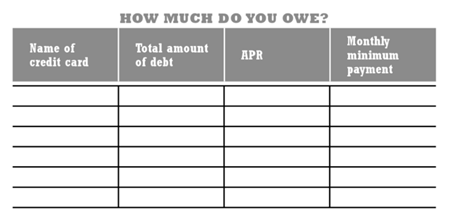
Go through your account statements, call the companies, do whatever it takes to find out how much you owe on these bills. You can use this tool to track it (it’s the second link on this list). The chart looks like this:


It’ll help you find out how much you owe to each company and what your interest rates are. You can also use my free online tool here.
Stop right now and do this.
Done?
Congrats! Taking the first step is one of the hardest parts — now you’re well on your way to a Rich Life.
If your total debt number seems high, remember two things:
  1. There is a large group of people with MORE debt than you.
  2. From this day that number is only going to go DOWN. This is the beginning of the end.

Step 2: Decide what to pay first

Once you know exactly how much you owe, you’re ready to strategically attack your debt.
To do this, you need to prioritize which of your debts you’re going to pay off first — whether it be your credit card, student loans, whatever — based on the interest rate.
You’re going to want to pay off the loan with the highest interest rate first and foremost.
For example, if Credit Card A has a balance of $1000 with a 12% interest rate and Credit Card B has $1500 at 6% interest, you’re going to save A LOT more money if you focused on eliminating Credit Card A.
Once you’ve decided what you should prioritize, it’s time to come up with a plan of attack.
When it comes to your student loans, you can actually save thousands of dollars each year — by spending more each month.
Yes, you read that right. You can save money by spending MORE.
Let’s say you have a $10,000 student loan, at a 6.8% interest rate and a 10-year repayment period.
If you go with the standard monthly payment, you’ll pay around $115/month.
But check out how much you can save per year if you paid just $100 more each month:

Like I said before, paying the minimum digs you into a bigger hole. Even $20 more per month can save you huge amounts of money.
I’ve written about this before and linked to two great articles regarding the tactic. If you can contribute even a small amount more per month, the benefits can be significant. See for yourself by calculating your savings using this calculator.
Alternatively, you can use the “debt snowball” method which I explain here (at around 2:00):

Step 3: Eliminate temptation

If you ever expect to pay down your debt, you can’t add more to it.
That’s why you need to do the following things:
  1. Take out your wallet.
  2. Dump out all your credit cards.
  3. Mail them all to Antarctica.
Well, maybe you don’t have to be that extreme…but the point is to remove all temptation of ever using your credit cards again until you’re out of debt.
Here’s my favorite tip: plunge your cards into a bowl of water and shove it all into your freezer.
Seriously.
Once you literally freeze your credit, you’ll have to chip away at a massive block of ice in order to get it back — giving you time to think about whether or not you want to go through with whatever purchase you were going to make.
Alternatively, you can lock them in a safe or have a friend/parent/sibling/whoever-you-trust hold on to them for you. As long as you’re not adding more to your credit card debt, any method is good.

Step 4: Negotiate a lower interest rate to save THOUSANDS

Not many people realize this, but you can actually save over $1,000 in interest with a single 5-minute phone call.
Through simple negotiations, you can lower the APR on your credit card and put thousands of dollars back into your pocket.
I LOVE negotiating interest rates.
It can be crazy simple too — in fact, here’s a word-for-word script that many of my readers have used already to lower their interest rates:
YOU: “Hi, I’m going to be paying off my credit card debt more aggressively beginning next week, and I’d like to lower my credit card’s interest rate.”
CC REP: “Uh, why?”
YOU: “I’ve decided to be more aggressive about paying off my debt, and that’s why I’d like to lower the interest rate I’m paying. Other cards are offering me rates at half what you’re offering. Can you lower my rate by 50% or only 40%?”
CC REP: “Hmmm…After reviewing your account, I’m afraid we can’t offer you a lower interest rate.”
YOU: “As I mentioned before, other credit cards are offering me zero percent introductory rates for 12 months, as well as APRs that are half what you’re offering. I’ve been a customer for XX years and I’d prefer not to switch my balance over to a lower-interest card. Can you match the other credit card rates, or can you at least go any lower?”
CC REP: “I see…Hmm, let me pull something up here. Fortunately, the system is suddenly letting me offer you a reduced APR. That is effective immediately.”
It’s really that simple to save money in 5 minutes.
Make the call, and if you’re successful, do two things:
  1. Celebrate your accomplishment (this is a big deal).
  2. Make sure to adjust your debt chart from step one. You get to chop that big ugly interest rate down and lower your monthly payments.
Repeat this process for any other cards you can, and then move on to my favorite step.

Step 5: Decide how you’re going to pay off your debt — and use Hidden Income to do it

If you’ve followed along this far, you’re probably thinking, “This is great and all, but where do I get the money to pay down all these bills?”
I recommend 4 things:
  1. Use the cash you’ve freed up from Step 4.
  2. Use money you have from your Conscious Spending Plan (this is how my friend spends over $21,000 a year on going out)
  3. Tap into Hidden Income
  4. Earn more money
I’ve already explained how to get cash from lowering your interest rates and you can learn more about creating a Conscious Spending Plan here.
Now, I want to show you how to get money with methods that’ll push your self-development to the next level and build a foundation for your Rich Life.

Tapping into Hidden Income

Instead of strict budgets or extreme frugality, I prefer to cut costs mercilessly on everyday bills. These are things like your cell phone, car insurance, and other monthly expenses.
Saving money on these everyday items is an easy way to free up cash to put toward your debt. The cool thing is, we can show you how to save $1,000 in a week — without cutting back on the things you love — like these people did:

It’s a great way to focus in on your willpower and expand your knowledge on how you spend money.
Try the challenge and see how much money you could put toward your next debt payment.

Earn More Money

I’ve always believed that there’s a limit to how much you can save but no limit to how much you can earn.
What does that have to do with paying off debt? Well, imagine having an extra $1,000/month (or more) that you could put toward your bills.
The best part: it’s far easier to earn $1,000 than to slash $1,000 from your budget.
Just a few examples of ways to earn more money:
  • Get a $5,000 raise with a simple, 15-minute conversation with your boss (this option is free).
  • Earn $1,000, $2,000, even $5,000 or more on the side, every month, while still keeping your day job.
  • Or — this is my favorite option — you could give yourself ultimate freedom and unlimited earning power with an online business.
Whatever you choose, the rewards can be huge and make a significant dent in your debt today.
Getting out of debt quickly is one of the best financial decisions you’ll ever make.
And earning more money is the secret weapon for paying down your debt as fast as possible.

Wipe out your debt — and live a Rich Life

Once you’ve eliminated your debt, congratulations!
You’ve not only beat a system designed to keep you drowning in debt, but you’ve also gained valuable knowledge and skills you can take with you on your journey to living a Rich Life.
But eliminating debt is just the first step on that journey.
Download a free copy of my Ultimate Guide to Making Money to learn my best strategies for creating multiple income streams, starting a business, and increasing your income by thousands of dollars a year.